
Pythagorean vs Chaldean numerology are the world’s two most widely used numerology systems. Chaldean assigns letter values 1 through 8 based on sound vibration and originates from ancient Babylon. Pythagorean assigns values 1 through 9 alphabetically and traces back to ancient Greece. The same name produces different results in each system.
These two systems share the same goal, extracting meaning from numbers hidden within a name or birth date – but they reach that goal through completely different philosophies. Chaldean numerology treats sound as the carrier of cosmic energy, assigning letters based on how they vibrate when spoken aloud. Pythagorean numerology treats the alphabet as a mathematical sequence, making it more structured and beginner-friendly. Understanding which system to use, and when, is the question every serious student of numerology eventually faces.
What Is the Core Difference Between Chaldean and Pythagorean Numerology?
The single most important difference between Pythagorean vs Chaldean numerology is how each system assigns numbers to letters. Chaldean uses sound vibration logic and assigns values 1 through 8 only, treating 9 as sacred. Pythagorean uses alphabetical sequence and assigns values 1 through 9. Because of this, the same name calculates to different numbers in each system.
That difference in letter assignment creates a ripple effect across everything else, the meanings you extract, the life areas you can analyze, and the conclusions you draw. The table below shows you the full contrast at a glance.
| Feature | Chaldean | Pythagorean |
|---|---|---|
| Origin | Babylon (~2500 BCE) | Ancient Greece (~570 BCE) |
| Letter values | 1 through 8 only | 1 through 9 |
| Assignment logic | Sound vibration | Alphabetical sequence |
| Compound numbers | Interpreted before reducing | Usually reduced immediately |
| Primary use | Name vibration, destiny, business names | Personality, inner character, life path |
| Best for | Name corrections, Vedic integration | Beginners, self-discovery, Western practice |
| Preferred in | India, Middle East, Eastern traditions | USA, Europe, Western contexts |
| Complexity | Higher | Simpler |
You can explore both systems using the name numerology calculator at checkmynumerology.com, which runs your name through both methods and shows you the results side by side.
Where Did Each System Come From?
Chaldean numerology emerged from the Chaldean civilization of ancient Mesopotamia over 4,500 years ago, while Pythagorean numerology was developed by the Greek philosopher Pythagoras around 570 BCE. The Chaldeans were priest-astrologers who believed spoken sound created measurable energetic patterns in the world. Pythagoras believed numbers were the universal language of truth, best expressed through clean mathematical sequence.
The Chaldean Origins: Sound, Babylon, and the Stars
The Chaldeans were not simply numerologists – they were astronomer-priests who mapped planetary energy onto the letters and sounds of language. Their core belief was that every spoken sound carries a vibration, and that vibration interacts with the energy field of the person who carries that name through life. This is why their number-to-letter assignments are not sequential. They assigned letters to numbers based on observed vibrational similarity, not alphabetical convenience.
The Chaldean system was passed down through oral priestly tradition for centuries before being documented. Its planetary associations tie directly into Vedic astrology, which is why practitioners in India and across the Middle East have maintained Chaldean numerology as the preferred method for name analysis and destiny work.
The Pythagorean Origins: Greece, Mathematics, and Self-Discovery
Pythagoras studied in Egypt and very likely in Babylon, which means he was almost certainly exposed to Chaldean numerology before developing his own system. His philosophical departure was deliberate. Where the Chaldeans leaned mystical and cosmic, Pythagoras leaned rational and mathematical. He believed the truest map of a human being’s inner nature was revealed through an orderly progression — A equals 1, B equals 2, and so on through 9, then cycling again.
This makes Pythagorean numerology extraordinarily accessible. There is no need to memorize irregular assignments. Any student can verify their own calculations with a simple alphabet chart. This also makes it the dominant system in Western New Age practice, where self-discovery tools work best when they are easy to learn and teach.
The connection between the both systems is underappreciated. Pythagoras did not invent numerology in a vacuum. He refined, simplified, and systematized a tradition that likely passed through his time in Babylon. The two systems are related, not independent – they are diverging interpretations of the same ancient observation that numbers carry meaning.
How Do the Letter-to-Number Charts Compare?
In Pythagorean numerology, every letter maps to a number from 1 through 9 in strict alphabetical sequence. In Chaldean numerology, letters map to numbers 1 through 8 based on vibrational similarity, and no letter maps to 9. The charts diverge significantly — most letters carry different values in each system, which is why the same name produces different totals.
Pythagorean Letter Chart (1 through 9)
| 1 | 2 | 3 | 4 | 5 | 6 | 7 | 8 | 9 |
|---|---|---|---|---|---|---|---|---|
| A, J, S | B, K, T | C, L, U | D, M, V | E, N, W | F, O, X | G, P, Y | H, Q, Z | I, R |
Chaldean Letter Chart (1 through 8)
| 1 | 2 | 3 | 4 | 5 | 6 | 7 | 8 |
|---|---|---|---|---|---|---|---|
| A, I, J, Q, Y | B, K, R | C, G, L, S | D, M, T | E, H, N, X | U, V, W | O, Z | F, P |
Notice that the letter R carries a value of 9 in Pythagorean but 2 in Chaldean. The letter S is 1 in Pythagorean but 3 in Chaldean. These are not minor differences – a name with several R’s and S’s will produce dramatically different results across the two systems. That divergence is intentional. It is the system working exactly as designed.
Why Does Chaldean Numerology Not Use the Number 9?
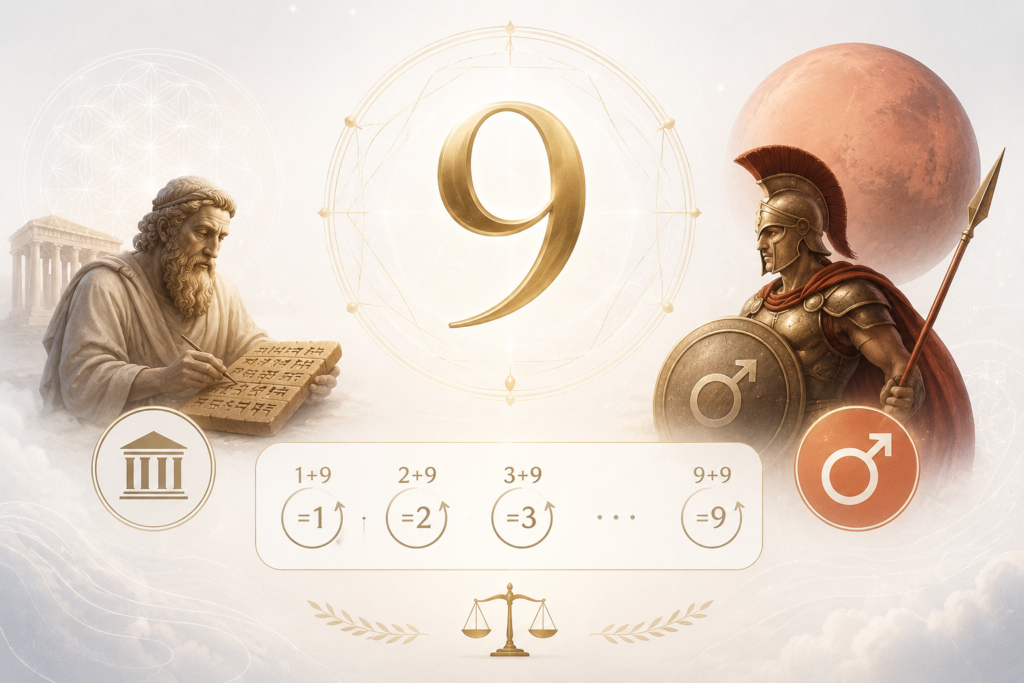
Chaldean numerology excludes 9 from letter assignments because the Chaldeans considered 9 to be cosmically complete and divine — adding 9 to any number always returns to the same digital root, making it mathematically self-contained. Assigning 9 to a letter would mix that divine completeness into ordinary human name energy, which the Chaldeans believed was philosophically incorrect.
This is one of the most searched questions in numerology, and the mathematical proof makes it immediately clear:
- 1 + 9 = 10 → 1 + 0 = 1
- 2 + 9 = 11 → 1 + 1 = 2
- 3 + 9 = 12 → 1 + 2 = 3
- 4 + 9 = 13 → 1 + 3 = 4
- 5 + 9 = 14 → 1 + 4 = 5
- 6 + 9 = 15 → 1 + 5 = 6
- 7 + 9 = 16 → 1 + 6 = 7
- 8 + 9 = 17 → 1 + 7 = 8
- 9 + 9 = 18 → 1 + 8 = 9
Every number you add 9 to returns its own digital root. The 9 vanishes. This mathematical property convinced the Chaldean priests that 9 existed at a different cosmic level – it belongs to the realm of the divine, not the realm of human names.
In Vedic numerology, 9 is the number of Mars, the planet of action, courage, and destruction. Mars energy operating at the level of personal name vibration was considered too volatile. The Pythagorean system, working from pure sequence, had no such philosophical concern — so I and R both carry 9 in that chart.
Full Calculation Walkthrough: The Same Name in Both Systems
The best way to understand Pythagorean vs Chaldean numerology is to work through the same name in both systems and see exactly where they agree and where they diverge. Here are three full examples with compound numbers included.
Example 1: English Name – “David King”
Pythagorean: D(4) + A(1) + V(4) + I(9) + D(4) = 22 → DAVID = 22 (Master Number, not reduced) K(2) + I(9) + N(5) + G(7) = 23 → 2 + 3 = 5 Total Name Number: 22 + 5 = 27 → 2 + 7 = 9
Chaldean: D(4) + A(1) + V(6) + I(1) + D(4) = 16 → DAVID = 16 → 1 + 6 = 7 K(2) + I(1) + N(5) + G(3) = 11 → 1 + 1 = 2 Total Name Number: 16 + 11 = 27 → 2 + 7 = 9
In this case both systems agree on a final number of 9 — but they arrive through completely different compound numbers. The Pythagorean reading carries the weight of the Master Number 22 within David’s first name. The Chaldean reading shows a 16 — a compound number known in Chaldean tradition as “the fallen tower,” associated with sudden change and rebuilding. Same final digit, profoundly different inner message.
Example 2: Indian Name – “Priya Sharma”
Pythagorean: P(7) + R(9) + I(9) + Y(7) + A(1) = 33 → PRIYA = 33 (Master Number) S(1) + H(8) + A(1) + R(9) + M(4) + A(1) = 24 → 2 + 4 = 6 Total: 33 + 6 = 39 → 3 + 9 = 12 → 1 + 2 = 3
Chaldean: P(8) + R(2) + I(1) + Y(1) + A(1) = 13 → PRIYA = 13 → 1 + 3 = 4 S(3) + H(5) + A(1) + R(2) + M(4) + A(1) = 16 → 1 + 6 = 7 Total: 13 + 16 = 29 → 2 + 9 = 11 → 1 + 1 = 2
Here the systems diverge completely. Pythagorean gives a 3 (creative expression, communication), while Chaldean gives a 2 (intuition, partnership, sensitivity). A Vedic numerologist working with this name would use the Chaldean result of 2 for destiny and external life path, and the Pythagorean result of 3 for understanding Priya’s inner expressive nature. Both are correct — they are measuring different layers of the same person.
Example 3: Business Name – “Nova Tech”
Pythagorean: N(5) + O(6) + V(4) + A(1) = 16 → 1 + 6 = 7 → NOVA = 7 T(2) + E(5) + C(3) + H(8) = 18 → 1 + 8 = 9 → TECH = 9 Total: 7 + 9 = 16 → 1 + 6 = 7
Chaldean: N(5) + O(7) + V(6) + A(1) = 19 → 1 + 9 = 10 → 1 + 0 = 1 → NOVA = 1 T(4) + E(5) + C(3) + H(5) = 17 → 1 + 7 = 8 → TECH = 8 Total: 19 + 17 = 36 → 3 + 6 = 9
For a business name analysis, a Chaldean practitioner would focus on that compound 19 within NOVA – in Chaldean tradition, 19 is “the Sun number,” associated with success, fame, and recognition. This gives the business name an additional layer of positive prognosis that the Pythagorean system simply does not surface at that level of granularity.
What Are Compound Numbers and Why Do They Matter in Chaldean Numerology?
In Chaldean numerology, compound numbers are the two-digit totals you reach before reducing to a single digit, and they carry their own Clear-cut meaning. Unlike Pythagorean numerology, which generally reduces straight to a single digit, the Chaldean system treats compound numbers as full interpretive data. Two people with the same final number can have totally different compound profiles.
Key Chaldean Compound Numbers You Should Know
| Compound Number | Name in Tradition | Meaning |
|---|---|---|
| 10 | The Wheel of Fortune | Success through completion of cycles |
| 13 | The Regenerator | Transformation, change, rebuilding after endings |
| 14 | The Adventurer | Freedom, risk, movement, unpredictability |
| 16 | The Shattered Tower | Sudden change, illusion broken, necessary destruction |
| 19 | The Sun | Fame, recognition, success, strong individual destiny |
| 22 | The Master Builder | Large-scale achievement, structural thinking |
| 23 | The Royal Star | Protection, favor, steady success |
Consider two names that both reduce to the number 4. One arrives through compound 13 – “the transformer” – suggesting a life built through repeated endings and rebuilding. The other arrives through compound 22 – “the master builder” – suggesting a life of structural achievement and lasting legacy. The final single digit is the same. The actual destiny reading is totally different. This compound layer is the main reason Chaldean numerology is considered more refined for name and destiny analysis.
What Does Sound Vibration Actually Mean in Chaldean Numerology?
Sound vibration in Chaldean numerology indicate to the physical and energetic frequency a spoken letter creates – the Chaldeans grouped letters under the same number because they believed those letters produced similar resonance when spoken aloud. This is not metaphor. The ancient Chaldeans observed that sound creates physical patterns, and that names spoken repeatedly build an energetic field around their bearer.
The modern science of cymatics demonstrates that sound does create measurable physical patterns – different frequencies produce distinct geometric forms in matter. The Chaldeans had no electron microscope, but they observed the effects of sound on human experience over centuries and codified what they found.
In Vedic tradition, the same principle underlies Mantra Shastra – the sacred science of Sanskrit sound. Each Sanskrit syllable is assigned to a cosmic force not because of its alphabetical position but because of the vibration it produces in the body when chanted. Chaldean numerology and Vedic mantra science share the same foundational logic: sound is not symbolic, it is causal.
This is why Chaldean numerology is the preferred system for name corrections. When you change a letter in your name to shift the number, you also change the sound you hear yourself called by every day. The vibration changes in physical reality, not just on paper.
Which System Should You Use? A Practical Decision Guide
Pythagorean numerology is best for understanding your inner personality and life path number, while Chaldean numerology is best for name vibration analysis, business names, and destiny work. For birth date calculations like the life path number, both systems agree completely because no letter assignments are involved — only pure arithmetic on date digits.
Use this decision framework:
| Your Purpose | Recommended System | Why |
|---|---|---|
| Analyzing your business name | Chaldean | Sound vibration affects how clients receive your brand |
| Understanding your inner personality | Pythagorean | Designed specifically for inner-character mapping |
| Calculating your Life Path Number | Either — results are identical | Birth date math uses no letter assignments |
| Name correction or spelling change | Chaldean | Sound-based change creates real vibrational shift |
| First time learning numerology | Pythagorean | Simpler sequential logic, easy to self-verify |
| Vedic astrology integration | Chaldean | Shares planetary sound principles with Jyotish |
| Western astrology integration | Pythagorean | Shares rationalist-mathematical philosophy |
| Baby name selection | Chaldean | Long-term vibration analysis for an entire lifetime |
Calculate your life path number using either system at the life path number calculator – the result will be the same because life path numbers come from your birth date, not your name.
When Both Systems Give You Different Numbers – What Do You Do?
When Pythagorean vs Chaldean numerology produce different results for the same name, treat the two numbers as two diagnostic lenses rather than two contradictory answers. The Chaldean result describes how external reality receives your name energy — your destiny, public life, and what the world calls toward you. The Pythagorean result describes your inner nature as expressed through the letters of your name — your temperament, inner drives, and personal growth patterns.
Both can be simultaneously true. A person whose name reads as 8 in Chaldean (authority, material mastery, power in the external world) and 5 in Pythagorean (freedom-seeking, adaptable, intellectually restless) is not receiving contradictory information. They are receiving a full portrait: someone whose inner nature craves freedom but whose external life calls them toward positions of responsibility and structure. Many highly successful people fit exactly this profile.
The practical rule is straightforward. Use Chaldean for external decisions, business names, name corrections, brand analysis, marriage name considerations. Use Pythagorean for internal reflection – personality exploration, relationship compatibility, understanding your core motivations and growth areas.
How Vedic Numerologists Use Both Systems Together
Most experienced Vedic numerologists use both Pythagorean and Chaldean numerology both together rather than choosing one entirely. Pythagorean handles birth date analysis (life path, psychic number, destiny number from date math). Chaldean handles name analysis (expression number, name vibration, compound number reading). Together they produce a complete portrait of both inner character and outer destiny.
How to Use Pythagorean and Chaldean Numerology Together, Step-by-Step Dual System Workflow
Calculate Your Life Path Number
Use your full birth date and reduce to a single digit. Both systems give the same result for date math.
Calculate Your Psychic Number
Take the day of your birth only and reduce it to a single digit.
Calculate Name Expression Number (Chaldean)
Use the Chaldean chart to assign values to each letter of your full name and reduce to a final number.
Note the Compound Number
Record the two-digit total before reducing. This compound number carries additional meaning in Chaldean.
Calculate Name Number (Pythagorean)
Run the same name through the Pythagorean chart for your inner character reading.
Check for Convergence
If both systems return the same final digit, treat it as a strong confirmation.
Handle Divergence
If results differ, use Chaldean for external decisions and Pythagorean for inner reflection.
Integrate With Birth Chart
Cross-reference both readings with your Vedic birth chart for a complete analysis.
Tools:
- Pythagorean Letter Chart
- Chaldean Letter Chart
- Name Numerology Calculator
- Birth Date
You can start this process using the numerology tools at our website, which supports both calculation methods.
Which Numerology System Is More Popular Where?
The country-by-country preference data for numerology systems shows a clear East-West divide rooted in cultural and philosophical tradition. India and the Middle East favor Chaldean due to its Vedic and Babylonian connections. The USA and Europe favor Pythagorean due to New Age and rationalist traditions. No single system dominates globally.
| Country or Region | Preferred System | Cultural Reason |
|---|---|---|
| India | Chaldean | Ties to Vedic astrology and planetary destiny framework |
| Middle East | Chaldean | Babylonian historical and mystical roots |
| USA | Pythagorean | New Age personal development focus |
| Europe | Pythagorean | Rationalist and philosophical tradition |
| Australia | Mixed | Multicultural practitioner preferences |
| China | Neither dominant | Own system: BaZi, Lo Shu Grid numerology |
| Latin America | Pythagorean | Strong New Age influence in spiritual communities |
If you are exploring East Asian numerology traditions alongside Western systems, you can also explore the Matrix Destiny Chart Calculator for a completely different and equally powerful numerological framework.
Common Mistakes People Make When Choosing Between These Systems
Mistake 1: Using Pythagorean for name correction decisions. Name correction is a Chaldean domain. Pythagorean was not designed for destiny-based name analysis. Using it for a name change decision is like using a personality test to predict external business outcomes — it measures the wrong dimension.
Mistake 2: Assuming the “better” system gives the higher number. Higher is not better in numerology. A name number of 8 is not superior to a name number of 3. Applying a good-bad judgment to the number itself misses the point of both systems.
Mistake 3: Ignoring compound numbers. Most beginners reduce straight to a single digit and stop there. In Chaldean numerology, the compound number before reduction carries critical interpretive data. A name that totals 16 before reducing to 7 carries fundamentally different energy than a name that totals 25 before reducing to 7. Both arrive at 7. Both are completely different destiny profiles.
Mistake 4: Running only one system and treating it as complete. Serious practitioners use both. Using only Pythagorean gives you rich inner-character data but no compound destiny layer. Using only Chaldean gives you name vibration analysis but less developed personality mapping. The full picture requires both lenses.
Mistake 5: Applying the wrong system to birth date calculations. Your Life Path Number comes from your birth date, not your name. Since no letter assignments are involved in birth date calculation, both systems produce the exact same life path result. Switching systems to try to get a different life path number will not work.
Frequently Asked Questions
What is the main difference between Chaldean and Pythagorean numerology?
Chaldean assigns letters values 1 through 8 based on sound vibration and originates from ancient Babylon. Pythagorean assigns letters values 1 through 9 in alphabetical sequence and comes from ancient Greece. Because the letter assignments differ, the same name produces different numbers in each system.
Which numerology system is more accurate?
Neither system is universally more accurate — they measure different things. Chaldean is considered more accurate for name vibration and destiny analysis because it uses sound frequency logic. Pythagorean is considered more accurate for inner personality mapping because it was specifically designed to reveal character. The most accurate reading uses both together.
Why doesn’t Chaldean numerology use the number 9?
The Chaldeans treated 9 as cosmically complete and divine. Adding 9 to any number always returns the original digital root, making 9 mathematically self-contained. Assigning it to a letter would mix divine completeness into human name energy, which the Chaldeans considered philosophically incorrect. In Vedic numerology, 9 also represents Mars — a planetary energy the Chaldeans kept separate from personal name vibration.
Does my name number change depending on which system I use?
Yes — in most cases your name produces different numbers in Chaldean vs Pythagorean because the letter value charts are significantly different. Your Life Path Number does not change between systems because it is calculated from your birth date using pure arithmetic, with no letter assignments involved.
Can I use both Chaldean and Pythagorean numerology at the same time?
Yes, and most experienced practitioners do exactly this. Use Pythagorean for birth date analysis and inner personality work. Use Chaldean for name analysis, business name evaluation, and destiny readings. The two systems complement each other when applied to their respective domains.
Which system should a complete beginner start with?
Start with Pythagorean. The letter chart follows a simple 1-through-9 alphabetical sequence that any student can memorize and self-verify quickly. Once you understand the core concepts — how numbers reduce, what each single digit means, how to calculate an expression number — you will find it much easier to layer in the Chaldean system and its more complex sound-vibration logic.
What are compound numbers in Chaldean numerology?
Compound numbers are the two-digit totals a name produces before being reduced to a single digit. In Chaldean numerology, each compound number from 10 through 52 carries its own distinct meaning. For example, a name that totals 19 before reducing to 1 carries “the Sun” energy — associated with fame and recognition — which is very different from a name that totals 10 before reducing to 1, which carries a “wheel of fortune” pattern.
Which system do most Vedic numerologists prefer for name analysis?
Most Vedic numerologists prefer Chaldean for name analysis because of its direct alignment with Vedic planetary principles and its shared philosophical foundation with Mantra Shastra. However, many Vedic practitioners also use Pythagorean for birth date calculations and inner personality work, treating the two systems as complementary rather than competing.
References:
- Pythagoras — Stanford Encyclopedia of Philosophy: plato.stanford.edu
- Jyotisha Journal, Vol. 10 Issue 1 (2025) — Peer-reviewed comparison of Chaldean and Pythagorean methodological approaches
