
Most people have no idea why new acquaintances form snap judgements about them that feel completely off base. This mismatch between how you see yourself and how strangers read you within seconds can be confusing, and it repeats in job interviews, first dates, and networking events without an obvious cause. Your personality number meaning explains exactly why that gap exists and gives you a clear method to calculate your own.
What Is a Personality Number?
A personality number is a single digit (or master number 11, 22, or 33) calculated from the consonants in your full birth name in numerology. It reveals the first impression you make on strangers, the outer image you project before people know you well, rather than your inner motivations or full potential.
Numerologists treat your birth name as a code, with vowels and consonants carrying different information. The vowels reveal your Soul Urge, your private wants and feelings, while the consonants reveal your Personality, the surface-level self that greets the world. Think of it as the numerology equivalent of a first handshake: quick, visible, and not the whole story.
This number sits alongside your Life Path Number as one of the core figures in a full numerology chart, but it answers a narrower, more specific question: what do people notice about you before they actually get to know you?
Why Consonants Specifically
Consonants form the structural sounds of a name, the hard edges you hear clearly even across a noisy room, and numerologists have long linked that acoustic quality to outward expression rather than inner feeling. Vowels, by contrast, carry the breath and softness of a name, which is why they map to the Soul Urge instead.
Personality Number vs. Other Core Numbers
The personality number differs from other core numbers by its narrow focus on first impressions and outward image, while the Life Path Number covers your overall life direction, the Soul Urge Number reveals inner desires, and the Expression Number represents your full natural potential across every letter of your name.
Understanding where the personality number fits inside a broader numerology chart makes each individual number more useful, because none of these figures work in isolation. They describe different layers of the same person, and comparing them side by side removes most of the confusion beginners run into.
Personality Number vs. Life Path Number
Your Life Path Number comes from your birth date and describes your overall direction and lessons across a lifetime. Your personality number comes from your birth name and describes only the surface impression you create in the first minutes of meeting someone. One maps your journey; the other maps your handshake.
Personality Number vs. Soul Urge (Heart’s Desire) Number
The Soul Urge Number is built from the vowels in your name and reflects what you privately want and value, independent of how anyone perceives you. Your personality number, built from the consonants, reflects the opposite side of that same name: the version other people meet before they know your private motivations.
Personality Number vs. Expression (Destiny) Number
Your Expression Number combines every letter, vowels and consonants together, into one number representing your complete natural potential. The personality number is essentially a slice of that total picture, isolating only the outward-facing portion.
| Number | Derived From | What It Reveals | When It Shows |
|---|---|---|---|
| Personality Number | Consonants only | Your outward image and first impression | Within seconds of meeting someone new |
| Soul Urge (Heart’s Desire) Number | Vowels only | Your private motivations and inner wants | Once someone earns your trust |
| Expression (Destiny) Number | All letters | Your full natural potential and abilities | Across your entire life, in your choices and work |
| Life Path Number | Birth date | Your overall direction and major life lessons | Across your entire life, in circumstances |
How to Calculate Your Personality Number
To calculate your personality number, write your full birth name, isolate every consonant, convert each consonant to its Pythagorean numeric value, add the values within each name part separately, reduce each part to a single digit or master number, then add those results together and reduce once more.
The steps below break this down so you can work through your own name without a calculator, though checking your math against an interactive tool is a smart way to confirm your result once you finish.
Step 1: Write Your Full Birth Name
Use the complete name on your birth certificate, first, middle, and last, not a married name or nickname. This distinction matters more than most guides admit, and the edge cases around it get their own section later in this article.
Step 2: Identify the Consonants
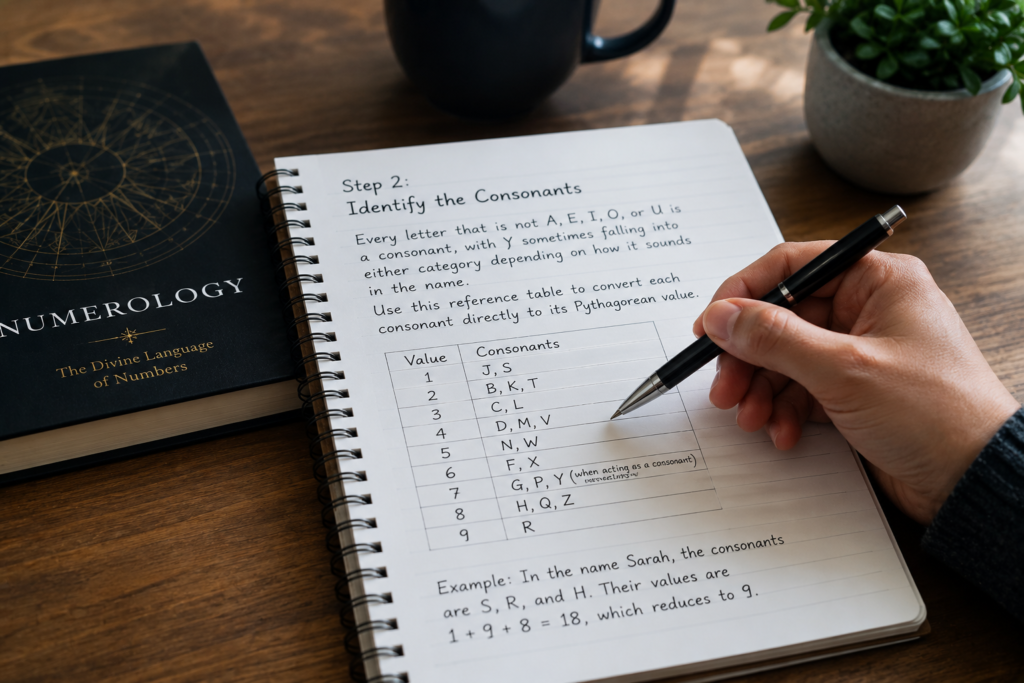
Every letter that is not A, E, I, O, or U is a consonant, with Y sometimes falling into either category depending on how it sounds in the name. Use this reference table to convert each consonant directly to its Pythagorean value.
| Value | Consonants |
|---|---|
| 1 | J, S |
| 2 | B, K, T |
| 3 | C, L |
| 4 | D, M, V |
| 5 | N, W |
| 6 | F, X |
| 7 | G, P, Y (when acting as a consonant) |
| 8 | H, Q, Z |
| 9 | R |
Step 3: Convert Letters to Numbers
Go through your first name, middle name, and last name separately, writing the numeric value under each consonant using the table above. Keep the three name parts distinct instead of merging them into one long string of letters.
Step 4: Add and Reduce Each Name Separately
Add the values within your first name and reduce the total to a single digit, unless the total is 11, 22, or 33, in which case you leave it as a master number. Repeat this same process independently for your middle name and last name.
Step 5: Combine and Reduce to a Final Number
Add the three reduced totals together, then reduce that final sum to a single digit or leave it as a master number if it lands on 11, 22, or 33. That result is your personality number.
Worked Example: Emma Grace Bennett
First name, EMMA: consonants are M, M. M = 4, so 4 + 4 = 8. Already a single digit.
Middle name, GRACE: consonants are G, R, C. G = 7, R = 9, C = 3, so 7 + 9 + 3 = 19, which reduces to 1 + 9 = 10, then 1 + 0 = 1.
Last name, BENNETT: consonants are B, N, N, T, T. B = 2, N = 5, N = 5, T = 2, T = 2, so 2 + 5 + 5 + 2 + 2 = 16, which reduces to 1 + 6 = 7.
Final total: 8 + 1 + 7 = 16, which reduces to 1 + 6 = 7. Emma Grace Bennett has a personality number of 7, projecting a reserved, intelligent, and somewhat private outer image.
Common Mistakes When Calculating
- Adding all consonants in one continuous string instead of reducing each name part separately, which can hide true master numbers or create false ones.
- Using a married name or nickname instead of the full birth name from the birth certificate.
- Forgetting Y can be a consonant, especially in names like Yolanda or Bryce, and leaving it out entirely.
- Reducing 11, 22, or 33 too early, collapsing a master number down to a single digit before the final calculation is complete.
- Skipping the middle name, which changes the entire outcome if a middle name is present on the birth certificate.
The Y Rule: Vowel or Consonant?
The letter Y counts as a consonant in numerology when it precedes a vowel sound or acts as the only sound-producing letter in a syllable that already contains another vowel, and it counts as a vowel when it is the sole vowel sound in a syllable, such as in Lynn or Bryce.
This single letter causes more confusion than any other part of the calculation, so working through several real names side by side clears up the pattern faster than a rule stated in the abstract.
Y as a consonant: Yolanda, Yara, Toyota, Hayley, Murray. In each case, Y either starts a syllable with a following vowel sound or follows a vowel without producing its own separate vowel sound.
Y as a vowel: Lynn, Bryce, Wyatt, Mary, Betty. Here Y is the only vowel sound in its syllable, functioning exactly like A, E, I, O, or U would.
What If You Don’t Reduce Cleanly? Master Numbers Explained
Master numbers in numerology are 11, 22, and 33, and they are never reduced to a single digit at any stage of the calculation because they are believed to carry amplified, more intense versions of the traits associated with 2, 4, and 6. Most numerologists do not recognize 44 as a legitimate master number.
If your personality number calculation lands on 11, 22, or 33 at any point, whether within a single name part or in the final total, stop reducing and keep that number as your result. Some numerologists argue 44 deserves the same treatment, but the more widely accepted view excludes it because 4 falls outside the traditional Triangle of Enlightenment formed by 1, 2, and 3. Read a full breakdown on the master numbers page if your name produces one of these figures.
Personality Number Meanings (1 Through 9)
Each single-digit personality number from 1 through 9 describes a distinct first impression, ranging from the confident, driven presence of a 1 to the charismatic, idealistic presence of a 9, and understanding your number helps explain patterns in how strangers, coworkers, and new acquaintances tend to react to you.
Personality Number 1
People read a Personality 1 as determined, self-assured, and quietly in charge of the room. Strangers rarely see you as a pushover, and that confidence opens doors quickly in professional settings. Watch for coming across as unreceptive or intimidating before people have a chance to see your warmer side.
Personality Number 2
People read a Personality 2 as warm, approachable, and trustworthy within minutes of meeting you. Strangers tend to open up to you fast and ask for help or advice. Watch for being mistaken as indecisive or easily pushed around, since your calm exterior can be misread as a lack of backbone.
Personality Number 3
People read a Personality 3 as creative, witty, and socially magnetic. Your energy tends to lift a room and draw people toward you without much effort. Watch for appearing superficial or exaggerated, especially if your charm outpaces the substance behind it in a first conversation.
Personality Number 4
People read a Personality 4 as dependable, organized, and steady under pressure. Colleagues trust your judgment on practical matters almost immediately. Watch for coming across as rigid or overly serious, since your no-nonsense presence can read as dull before people see your loyalty and follow-through.
Personality Number 5
People read a Personality 5 as adventurous, energetic, and quick to embrace change. Strangers find your restlessness exciting rather than off-putting. Watch for seeming unreliable or scattered, since constant motion can make people doubt whether you will follow through on commitments.
Personality Number 6
People read a Personality 6 as caring, responsible, and easy to approach with problems. Strangers instinctively treat you as a shoulder to lean on. Watch for being taken advantage of, since your agreeable nature can invite people to overstep boundaries you never actually set.
Personality Number 7
People read a Personality 7 as intelligent, private, and slightly mysterious. Strangers sense there is more beneath the surface and often find that intriguing rather than distant. Watch for appearing arrogant or unapproachable, especially in fast-paced social settings that reward quick warmth over depth.
Personality Number 8
People read a Personality 8 as powerful, competent, and clearly in control. Strangers assume you make sound decisions and trust your business instincts fast. Watch for coming across as materialistic or domineering, particularly in casual settings where authority is not the priority.
Personality Number 9
People read a Personality 9 as charismatic, idealistic, and almost regal in presence. Strangers often feel drawn to your confidence and sense of purpose. Watch for appearing aloof or entitled, since a strong presence can tip into arrogance if left unchecked.
Master Personality Numbers
Personality Number 11
An 11 Personality projects heightened sensitivity and an almost electric intensity that people notice immediately, even if they cannot name what they are sensing. Strangers often describe you as intuitive or unusually perceptive within a first conversation. The tradeoff is a tendency to seem overwhelmed or emotionally raw in high-pressure situations.
Personality Number 22
A 22 Personality projects quiet, large-scale reliability, the sense that you could be trusted to run something important. People pick up on your consistency fast, even before they understand why they trust you. The tradeoff is a visible undercurrent of self-doubt that can surface under scrutiny.
Personality Number 33
A 33 Personality projects a nurturing, almost parental warmth layered with genuine artistic sensitivity. People are drawn to you the way they are drawn to a natural caretaker or creative mentor. The tradeoff is heightened vulnerability to criticism and a tendency to misjudge who deserves that trust.
Special Cases: Adoption, Name Changes, and Nicknames
For personality number calculations, most numerologists recommend using the name on your original birth certificate rather than an adopted name, married name, or nickname, because the birth name is treated as the foundational vibrational imprint. A nickname produces a separate figure called a minor personality number instead of replacing the original.
Which Name Do You Use If You Were Adopted?
The standard guidance favors the original birth name unless the adoption happened in early infancy, in which case some numerologists accept the adopted name as the practical substitute. This remains one of the more debated corners of numerology, so treat it as a judgment call rather than a fixed rule.
Does Legally Changing Your Name Change Your Personality Number?
A legal name change, including a married name, does not erase your original birth-name personality number, which numerologists treat as your permanent foundational imprint. Instead, the new name creates an additional, secondary influence that layers on top of the original rather than replacing it.
What Is a Minor (Nickname) Personality Number?
A minor personality number is calculated the same way as your main personality number, but using the consonants from a nickname instead of your full birth name. It reflects a smaller, more situational layer of how people perceive you in casual settings, and it sits alongside, not instead of, your primary result.
How to Use Your Personality Number
The most practical use of a personality number is comparing it against your Soul Urge Number to see how closely your outer image matches your private motivations, since a close match suggests an authentic presentation while a wide gap suggests people frequently misread your true intentions.
Pull both numbers side by side once you have them. If they match closely, what you show the world lines up with what you actually want, and people who meet you tend to read you accurately from the start. If they diverge sharply, for example a guarded, private 7 Personality paired with a warm, people-focused Soul Urge, expect regular friction between how you feel inside and how strangers initially size you up. Neither pattern is better than the other; awareness of the gap is what makes it useful, since it lets you decide when to let more of your inner self show and when to lean on your outer presentation strategically.
Is Numerology (and the Personality Number) Accurate?
Numerology, including the personality number, is not supported by scientific evidence and is generally classified as a pseudoscience or a symbolic self-reflection tool rather than a predictive science. Many people still find value in it as a structured framework for thinking about personality and first impressions, similar to how some use astrology or the Myers-Briggs framework.
Treat the personality number the way you would treat a well-designed personality quiz: not a verified scientific instrument, but a structured lens that can prompt genuinely useful self-reflection. Psychologists who study first impressions confirm that snap judgments happen within seconds of meeting someone and are shaped heavily by visible, surface-level cues, which is the same territory numerology’s personality number is trying to describe using a different vocabulary. Reading it with that framing, curious rather than literal, tends to produce the most honest and useful results.
Frequently Asked Questions
What is a personality number in numerology?
A personality number is a single digit or master number calculated from the consonants in your full birth name. It reveals the first impression you make on people before they know you well, distinct from your inner motivations or overall life path.
What is the difference between personality number and soul urge number?
Identify the consonants in each part of your birth name, convert them to numbers using the Pythagorean chart, and add them within each name part separately. Reduce each part to a single digit or master number, then add all three results together and reduce once more for your final personality number.
What is the difference between personality number and soul urge number?
The personality number comes from the consonants in your name and reflects your outward image. The soul urge number comes from the vowels and reflects your private inner desires, making the two numbers opposite halves of the same name.
Is the letter Y a vowel or a consonant in numerology?
Y functions as a consonant when it precedes a vowel sound or starts a syllable, as in Yolanda or Hayley. It functions as a vowel when it is the only vowel sound in its syllable, as in Lynn or Bryce.
Do you reduce master numbers like 11, 22, or 33 in the personality number?
No. If your calculation produces 11, 22, or 33 at any stage, leave it as is rather than reducing it further to a single digit. This applies whether the master number appears within a single name part or in the final combined total.
What is your personality number if you were adopted or changed your name?
Most numerologists recommend using your original birth certificate name rather than an adopted or legally changed name, since the birth name is treated as your foundational imprint. A later name change adds a secondary influence rather than replacing the original calculation.
Can your personality number change over time?
The personality number derived from your birth name is considered fixed and permanent. A legal name change can create an additional vibrational layer, but it does not overwrite or replace your original birth-name personality number.
What is the difference between personality number and life path number?
The life path number comes from your birth date and reflects your overall direction and major life lessons across a lifetime. The personality number comes from your birth name and reflects only the outward first impression you create when meeting someone new.
Final Thoughts
Your personality number meaning boils down to one clear idea: the consonants in your birth name calculate the outer image you project before anyone truly knows you, and that number stays consistent whether you are walking into a job interview or meeting someone for the first time at a party. Once you calculate yours using the steps above, compare it against your Soul Urge Number or run your full profile through a name numerology calculator to see how every piece of your chart fits together.
Sources:
